

Longo Toyota

#1 in the World since 1967*

Based on Toyota Motor Sales, USA 2025 Sales Report*
Based on Toyota Motor Sales, USA 2023 Sales Report*
Blog / Comparison

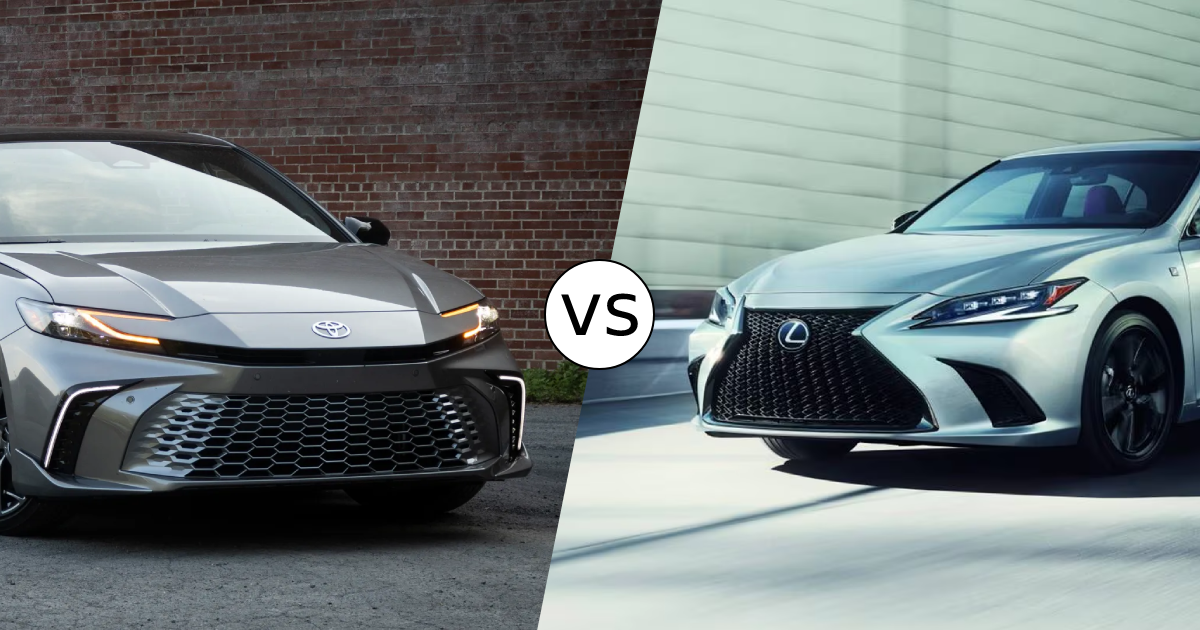
Toyota Camry vs. Lexus ES: Which is Right for You?

2025 Toyota Camry vs Lexus ES

When it comes to choosing a luxury sedan, the 2025 Toyota Camry and the 2025 Lexus ES consistently shine as top contenders. Both models showcase a perfect blend of style, performance, and cutting-edge technology. In this article, we'll compare the Toyota Camry and the Lexus ES to help you decide which luxury sedan aligns with your lifestyle and preferences.

Performance and Engine Options

Let's kick things off by examining what lies under the hood of these two impressive sedans. The 2025 Toyota Camry and the 2025 Lexus ES offer distinct performance and engine options tailored to different driving preferences. 

The Camry is available with exclusive hybrid powertrains, featuring a 2.5-liter four-cylinder engine paired with electric motors. The base front-wheel-drive (FWD) setup produces a combined 225 horsepower, while the all-wheel-drive (AWD) variant boosts this to 232 horsepower. The Camry's hybrid system provides smooth acceleration, with the FWD model accelerating from 0 to 60 mph in approximately 7.4 seconds and the AWD model in about 7.1 seconds. Fuel efficiency is a strong suit for the Camry, with the FWD variant delivering an impressive EPA-estimated 51 mpg combined and the AWD variant achieving around 47 mpg combined. 

In contrast, the 2025 Lexus ES offers a broader range of engine options, catering to both performance enthusiasts and those seeking luxury. The base ES 250 comes with a 2.5-liter four-cylinder engine that generates 203 horsepower and 184 Ib-ft of torque. Paired with an eight-speed automatic transmission and AWD, it accelerates from 0 to 60 mph in about 8.6 seconds and offers fuel efficiency of 25 mpg city and 34 mpg highway.

For more power, the ES 350 features a 3.5-liter V-6 engine delivering 302 horsepower and 267 Ib-ft of torque. With FWD, it achieves 0 to 60 mph in 6.6 seconds and has a fuel efficiency of 22 mpg city and 32 mpg highway. Additionally, the ES 300h hybrid model combines a 2.5-liter engine with electric motors to produce 215 horsepower, emphasizing fuel efficiency with an EPA-estimated 44 mpg combined and a 0-to-60 mph time of 8.1 seconds. The ES prioritizes a smooth and comfortable ride, while the F Sport trims add a touch of sportiness to the handling. 

Interior and Comfort

Both the Camry and the ES offer comfortable and stylish interiors. The Camry features soft-touch surfaces and a user-friendly layout, including an 8-inch touch screen and standard wireless Apple CarPlay and Android Auto. Higher trims, such as the XSE and XLE, come with a 12.3-inch display and JBL audio. With supportive seats and generous legroom, the Camry ensures comfort for both short and long drives.

The 2025 Lexus ES highlights luxury and refinement with premium materials such as leather upholstery and wood trims inspired by traditional Japanese swords. It includes a cutting-edge infotainment system with an 8-inch or optional 12.3-inch touch screen, wireless smartphone integration, Amazon Alexa, and a Wi-Fi hot spot. The spacious, plush seats provide excellent comfort, though the trunk space is slightly smaller at 13.9 cubic feet compared to the Camry's 15.1 cubic feet. Overall, the Lexus cabin experience is more serene and upscale.

Safety and Reliability

Both the Toyota Camry and the Lexus ES prioritize safety. The 2025 Camry features Toyota Safety Sense 3.0, which includes a precollision system, lane departure alert, and dynamic radar cruise control. It has received a Top Safety Pick+ rating from the Insurance Institute for Highway Safety (IIHS) for its crashworthiness. The Camry is also known for its reliability, backed by a three-year/36,000-mile limited warranty and a five-year/60,000-mile powertrain warranty, along with coverage for hybrid components.

Similarly, the Lexus ES excels in safety with its Lexus Safety System+ 2.5, featuring advanced technologies such as precollision systems, lane-tracing assist, and adaptive cruise control. It has earned a five-star overall safety rating from the National Highway Traffic Safety Administration and high marks from the IIHS. The ES also boasts strong reliability, reflected in its high J.D. Power score of 82 out of 100. It comes with a four-year/50,000-mile limited warranty, a six-year/70,000-mile powertrain warranty, and extensive hybrid coverage.

Cost of Ownership

The cost of ownership is a vital consideration for anyone looking to buy a new car. The Camry, known for its affordability and efficiency, has a lower overall cost of ownership, with a five-year estimate of around $33,867 on its base trim. This includes expenses such as depreciation, taxes, financing, fuel, insurance, maintenance, and repairs. 

Conversely, the Lexus ES, being a luxury vehicle, incurs higher costs, with a five-year estimate of around $53,690 on the base model. This higher cost is attributed to greater depreciation, more expensive insurance, and higher maintenance and repair expenses. However, the Lexus ES offers a more luxurious experience, which can justify the additional expense for those seeking premium comfort and features.

Pros and Cons Analysis

Let's break down the strengths and weaknesses of each model. The Toyota Camry boasts a more affordable price, excellent fuel efficiency, and a strong reputation for reliability. Its sporty handling makes it a fun drive, while the roomy interior offers plenty of space for passengers and cargo. However, some may find the Camry lacks the upscale materials and finishes that are hallmarks of luxury sedans.

On the other hand, the Lexus ES dazzles with its luxurious interior, premium features, and advanced safety technology. It also provides a smooth, quiet ride that enhances the overall driving experience. However, the higher price and potentially higher maintenance costs can be drawbacks for some buyers. Additionally, while it offers great performance, it may not match the sportiness of the Camry for those who crave a more dynamic driving experience.

Which Sedan Fits Your Lifestyle?

In this 2025 Toyota Camry vs. 2025 Lexus ES showdown, your choice ultimately boils down to what you value most in a vehicle. If you're looking for a reliable, budget-friendly sedan with a sporty edge, the Camry is the perfect choice. However, if your priorities are comfort and advanced features, the ES delivers a superior experience.

Whichever way you're leaning, at Longo Toyota in El Monte, California, we're ready to help you explore your options and make an informed decision. Visit us today to test-drive both models and discover which luxury sedan wins your heart. 

Posted in:

Related Posts

Red 2027 Toyota Corolla Hybrid parked on a road beside a classic white Corolla

2027 Toyota Corolla vs. Hybrid: Which Is Right for SGV Commuters?

Picture the I-10 crawl at 5 PM, or a longer I-605 run, or maybe a weekend drive toward the mountains. Your commute shapes which Corolla makes sense. At Longo Toyota in El Monte, we help SGV drivers weigh the 2027 Toyota Corolla vs. Hybrid choice every day. If you want a hand sorting it out, contact us anytime. Quick pick: Heavy stop-and-go driving or a long daily commute points to the hybrid. Short trips and a simpler setup can point to the gas Corolla. 2027 Toyota Corolla El Monte: Gas vs. Hybrid at Longo Toyota As the world’s largest Toyota dealership, Longo Toyota spans more than 50 acres at 3534 North Peck Road, giving you plenty of room to compare gas and hybrid models in a single visit. That makes us the premier destination for the 2027 Toyota Corolla El Monte shoppers are searching for, including the limited 2027 Corolla 60th Anniversary Edition. With just 2,500 units headed to dealers nationwide, our size gives you one of the best chances to secure an allocation. The 2027 Corolla is now arriving at Longo Toyota. The gas lineup includes the LE, SE and XSE, and the hybrid lineup offers the Hybrid LE, Hybrid SE and Hybrid XLE, plus the 60th Anniversary Edition. Browse our 2027 Corolla Hybrid inventory to see what’s on the lot. Gas vs. Hybrid MPG for SoCal Commutes on the I-10, I-605, and CA-60 Fuel economy is the biggest difference between the two Corollas. The table below compares the LE grades side by side. MPG figures are EPA-estimated, and real-world results vary with driving habits, conditions, and trim. Category Gas Corolla LE Corolla Hybrid LE Powertrain 2.0-liter Dynamic Force four-cylinder Toyota Hybrid System 5, 1.8-liter four-cylinder Drivetrain FWD FWD Transmission Dynamic Shift CVT Electronically controlled CVT Horsepower/torque 169 hp / 151 lb.-ft. 138 net combined hp City/highway MPG 32/41 53/46 Safety Toyota Safety Sense 3.0 Toyota Safety Sense 3.0 Corolla Hybrid MPG in Los Angeles vs. the Gas Corolla For 2027 Corolla Hybrid MPG Los Angeles drivers care about, the Hybrid LE FWD and Hybrid XLE are rated at 53 city, 46 highway, and 50 combined MPG. The Hybrid SE FWD is rated at 50 city and 43 highway. The gas LE is rated at 32 city and 41 highway MPG, the gas SE at 31 city and 40 highway, and the gas XSE at 31 city and 38 highway. If your week is packed with short city hops and errands, the hybrid's city rating works in your favor. A longer I-605 run at steady speed narrows the gap, so highway-heavy drivers may find the gas Corolla perfectly sensible. Stop-and-Go Traffic and High LA Gas Prices Hybrid systems favor low-speed traffic. When you creep along the CA-60 or I-10, the electric motor can help move the car at low speeds, and the system can recover energy while you slow down. That means less work for the gas engine in the very conditions that tend to burn the most fuel. With fuel costs a constant concern across Los Angeles, many commuters value that efficiency most in daily traffic. To see the hybrid up close, try a virtual test drive or call sales at 626-539-2113 (Mon - Sun 9 AM - 8 PM). Key Specs: Safety, Drivetrain, and Available AWD Both powertrains share the same safety package, and AWD is offered on select hybrids. A few details matter most on local roads. Toyota Safety Sense 3.0, Blind Spot Monitor, and Rear Cross-Traffic Alert Every grade comes standard with Toyota Safety Sense 3.0. It includes Pre-Collision System with Pedestrian Detection, Full-Speed Range Dynamic Radar Cruise Control, Lane Departure Alert with Steering Assist, Lane Tracing Assist, Road Sign Assist, Automatic High Beams, and Proactive Driving Assist. Radar cruise control is handy when traffic speeds up and slows down. Blind Spot Monitor is also standard on all grades. It warns you about vehicles in adjacent lanes, which is useful on busy freeway lane changes. Rear Cross-Traffic Alert detects vehicles approaching from either side while you back out, with visual and audible warnings. You'll appreciate it in crowded shopping center lots. Available AWD on LE and SE Hybrid for Mountain Driving Electronic On-Demand All-Wheel Drive is available on the Hybrid LE and Hybrid SE. If your weekends include a drive toward the mountains, extra traction may be worth discussing with us. If you stay on valley streets and freeways, FWD may be all you need. The 2027 Corolla 60th Anniversary Edition and the Best Commuter Car in the San Gabriel Valley The 2027 Corolla 60th Anniversary Edition was announced August 18, 2026. The 60th Anniversary Special Edition is based on the Hybrid SE and limited to just 2,500 U.S. units, so allocations are limited. Reserve yours early to secure one. It adds exclusive 18-inch machined, black-finished alloy wheels and custom 60th Anniversary exterior badging. Inside, the sport seats carry Black and Red Sport Fabric inserts. Standard features include a 10.5-inch Toyota Audio Multimedia system and 60th Anniversary door sills, along with custom floor mats. Colors are Ice Cap and Supersonic Red, which is exclusive to the Special Edition. If you are weighing the best commuter car San Gabriel Valley drivers might choose, this one pairs a hybrid commute with distinctive styling. Which Corolla Fits Your Commute? Questions to ask yourself: How many miles do you drive each day? How much of that is stop-and-go driving? Do you need added traction? The hybrid suits you if your days involve long crawls on the I-10 or CA-60, or lots of short errands. Steady highway miles and a preference for a simpler setup favor the gas model. Some drivers just like the 169 horsepower of the 2.0-liter engine, and that's reason enough. Reserve Your 2027 Model at Longo Toyota The 2027 Toyota Corolla vs. Hybrid decision comes down to how you drive. Explore the 2027 Toyota Corolla El Monte commuters are choosing on our 50-acre campus, or contact us to reserve your 2027 model, including the limited 60th Anniversary Edition, before allocations run out. Call 626-539-2113, and we’ll help you find your fit.

Orange 2027 Toyota Tundra TRD Pro driving across a desert off-road trail

2027 Toyota Tundra Trailhunter vs. TRD Pro: What's the Difference?

The short answer: the Trailhunter is an overlanding package based on the SR5, built to give you trail capability straight from the factory. The TRD Pro is a separate grade and the most off-road-focused version of the Tundra, with race-inspired hardware and a performance orientation. If you want to see what Toyota has in the showroom while you read, you can browse new Toyota inventory anytime. At Longo Toyota, we hear from plenty of El Monte and Southern California shoppers who want to understand the 2027 Toyota Tundra Trailhunter vs TRD Pro before they commit. Full 2027 specifications haven't been released yet, so this guide keeps the comparison high-level. Two Off-Road Tundras, Two Different Missions Both are built for rough ground, but they put the emphasis in different places. What they can do overlaps a lot. An overlanding-minded truck can run recreational trails, and a performance-minded truck can still carry you to a campsite. Trailhunter: Built for Overlanding The Trailhunter is a rugged overlanding package based on the SR5. Toyota aims it at customers who want strong trail performance from the factory, with genuine overlanding character. The idea is simple: the traction and suspension hardware you need for remote travel comes installed, along with underbody protection, so you start with a capable foundation. Even so, the badge doesn't guarantee every accessory an extended trip might call for. Plan your gear separately. TRD Pro: Built for Performance The TRD Pro is the most off-road-focused version of the Tundra. Toyota gives it race-inspired hardware and a distinctive visual identity, with a focus on how the truck handles rough terrain, mainly damping and stability. For 2027, that starts with newly designed, Tundra-tuned FOX enhanced shocks that are adjustable. An available TRD Performance package adds hardware and tuning for drivers who want more dynamic performance. Suspension Comparison This is where the two split most clearly. The Trailhunter rides on an Old Man Emu upgraded suspension. Over on the TRD Pro you’ll find newly designed, Tundra-tuned, adjustable FOX enhanced QS3 shocks, engineered for feel, stability and adjustability over rough terrain. Shocks control how the suspension moves after an impact and how it handles repeated bumps. The Trailhunter's setup supports its role as a trail-ready starting point. The TRD Pro's adjustable shocks put the emphasis on feel and control over broken surfaces. Springs, tires, and vehicle weight also shape ride quality, so a shock brand alone won't make one truck more capable. Toyota hasn't released 2027 suspension specifics yet, and we won't guess at measurements. Off-Road Equipment and Capability Equipment is where the Trailhunter's overlanding purpose shows up in hardware. The TRD Pro's list, so far, leans on its shocks, tow hooks, and available seating and performance options. Trailhunter Equipment for Remote Travel Toyota has outfitted the Trailhunter with several pieces of hardware that matter when you're far from pavement: Front recovery hooks give you a point to attach recovery gear. Additional underbody protection shields components from rocks and debris. Multi-Terrain Select adjusts the truck's response to different surfaces. Crawl Control helps manage low-speed progress over difficult ground. A locking rear differential helps when the rear wheels have uneven traction. Follow the manufacturer's instructions and ratings for any recovery work. A hook being there doesn't make it suitable for every technique. TRD Pro Equipment for Rugged Terrain The TRD Pro comes with standard red tow hooks, plus available ISO-dynamic seats designed to help support comfort and stability over rough terrain. The available TRD Performance package adds more hardware and tuning. Toyota hasn’t announced the rest of the 2027 TRD Pro equipment list or the package contents, so we aren’t making item-by-item comparisons yet. Wheels and Tires The Trailhunter rides on Michelin LTX Trail 265/70R18 tires and unique bronze-colored wheels. The tires are part of what makes the truck trail-ready, and the bronze finish gives it a distinct look. Toyota hasn't announced TRD Pro tire and wheel details for 2027. Tires affect loose-surface traction and ride comfort, and they change road noise and how a truck behaves in the wet. A more aggressive look won't necessarily mean better results in every condition. For loaded travel, check tire load ratings and recommended inflation pressures too. Exterior Styling and Design The 2027 Tundra's new design starts with the front end. Toyota describes crisp, square geometry, a wide stance, and a center lower-bumper treatment, with rectangular fog lights integrated into the bumper. A rugged hexagonal grille theme adapts to different trims, so the Trailhunter and TRD Pro each wear it their own way. On the TRD Pro, the distinctive visual identity now includes the new Honeycomb exterior color. On the Trailhunter, the bronze-colored wheels stand out. Keep in mind that styling and function are different things. Protection hardware and suspension add capability; a grille or paint color adds none. Which Adventures Suit Each Tundra? Both options can take you off pavement. The better fit depends on what you want the hardware to do. Whichever you lean toward, our virtual test drives are a handy way to start getting a feel for the Tundra lineup. Best for Overlanding and Extended Trips The Trailhunter fits destination-focused travel and camping access, and it suits long stretches on unpaved routes. Extended trips also depend on loaded weight and cargo organization, plus passenger comfort, so check trim-specific ratings before you pack. Choose the Trailhunter if: You want overlanding character and factory trail capability in one package. You value built-in recovery hooks and additional underbody protection. You want a locking rear differential, Multi-Terrain Select, and Crawl Control ready from day one. Best for Rough-Terrain Performance On rough terrain, the TRD Pro's appeal is how its hardware behaves. The adjustable FOX QS3 shocks are engineered for feel and stability over rough terrain. Performance branding is not a license for unsafe speed, so always match your pace to visibility and surface conditions, and follow access rules. Choose the TRD Pro if: You want race-inspired off-road hardware. You like the idea of adjustable shocks tuned for stability over rough terrain. You are interested in the available TRD Performance package and available ISO-dynamic seats. What Is Confirmed for 2027 and What Is an Expected Carryover? For the Trailhunter, Toyota has confirmed the Old Man Emu suspension, Michelin LTX Trail 265/70R18 tires, bronze-colored wheels, front recovery hooks, additional underbody protection, Multi-Terrain Select, Crawl Control, a locking rear differential and its SR5 foundation. On the TRD Pro side, confirmed items include the newly designed FOX enhanced shocks, standard red tow hooks, available ISO-dynamic seats, the available TRD Performance package and the new Honeycomb color. For reference, the 2026 TRD Pro has Multi-Terrain Select as standard. An electronically locking rear differential and Multi-Terrain Monitor are also standard. That is 2026 equipment. Toyota hasn't confirmed 2027 details for the TRD Pro in these areas, and we won't assume them. Toyota has said additional 2027 Tundra details and specifications are scheduled to be announced in fall 2026. The lineup continues with a twin-turbo V6 and an available i-FORCE MAX hybrid, but Toyota hasn’t yet said which powertrains pair with the Trailhunter package or the TRD Pro, or published 2027 horsepower and torque figures. Until then, treat anything beyond the list above as unconfirmed. Which 2027 Tundra Is the Better Choice for Most Buyers? Neither option wins for everyone. The right choice depends on how you use your truck, your budget, your comfort expectations, and your cargo needs. If you want an integrated foundation for destination-oriented travel, and the confirmed equipment matches your plans, the Trailhunter may suit you. Drivers drawn to race-inspired hardware, adjustable shocks, and available performance equipment, and who want that feel on rough terrain, should look at the TRD Pro. If most of your miles are on pavement around El Monte and greater Southern California, weigh daily ride quality, cabin usability, and parking against specialized off-road gear. A standard Tundra with the right options may serve you just as well. Compare equivalent configurations and verify equipment and final details before deciding. Shop New Tundra Inventory at Longo Toyota Longo Toyota sits on a 50-acre campus in El Monte, and we’re a full-service new and used Toyota dealership offering sales, leasing, financing, service, parts and collision repair. When you're ready to compare Tundra trims, browse new Toyota inventory to see what is available now. Specs and packages can change, so please confirm final details with us before buying, and review each truck's window sticker. Questions about the 2027 Toyota Tundra Trailhunter vs TRD Pro? Contact our team. If you're planning your purchase, you can also get pre-qualified for financing.

Front of Toyota Corolla

2026 Toyota Corolla vs. 2026 Nissan Sentra: Which Compact Sedan Wins?

Compact sedans remain some of the most practical vehicles on the market, and the 2026 Toyota Corolla and 2026 Nissan Sentra are two of the strongest options in the segment. Both deliver good value and competitive fuel efficiency at accessible price points, with modern features that punch above their price tag. Below is a side-by-side look at what each model brings to the table so you can decide which one fits your priorities. 2026 Toyota Corolla vs. 2026 Nissan Sentra: First Impressions The 2026 Toyota Corolla carries decades of earned reputation for reliability. Its cabin is practical, and the lineup is broad, including a popular hybrid variant with available AWD. The Nissan Sentra has matured into a genuinely competitive option, known for its smooth ride and standard safety features. Both cars make a strong case, but for different priorities. The Corolla's biggest wins come from its hybrid powertrain with available AWD, higher combined MPG across the lineup, ten standard airbags, and Toyota Safety Sense 3.0 on every grade. The Sentra counters with a slightly lower entry price and a bit more trunk space. Where they overlap: both use similarly sized 2.0L four-cylinder engines, both run CVT transmissions, and both seat five comfortably. If you'd like to compare trims in person, you can browse Corolla inventory at Longo Toyota in El Monte, CA, anytime. Quick Comparison Table: Pricing, Trims, and Key Specs Feature 2026 Toyota Corolla 2026 Nissan Sentra Available Grades LE, SE, XSE; Hybrid LE, SE, XLE S, SV, SR, SL Engine 2.0L Dynamic Force 4-cylinder 2.0L naturally aspirated 4-cylinder Horsepower/Torque 169 hp / 151 lb-ft 149 hp / 146 lb-ft Transmission CVT Xtronic CVT Combined MPG 35 (gas) / 50 (hybrid) 32-33 (varies by trim) Cargo Capacity 13.1 cu. ft. 14.3 cu. ft. AWD Availability Yes, on Hybrid grades No, FWD only Pricing and Trim Levels Compared Both sedans target budget-conscious buyers without sacrificing much comfort or technology, and both open at similar entry points in the compact segment. The Sentra starts marginally lower, but the gap is small enough that it rarely decides the purchase on its own. What separates them is what each dollar buys further up the range. The Corolla lineup runs from the well-equipped LE through the sportier SE and feature-rich XSE, then adds three separate hybrid grades in LE, SE, and XLE. That gives you six distinct configurations and a genuine choice between gas and hybrid at nearly every price point. Nissan keeps things simpler with S, SV, SR, and SL, and skips a hybrid option entirely, so Sentra buyers who want electrified efficiency have to look elsewhere. Pricing shifts with incentives, regional offers, and equipment, so the most reliable way to compare is against current inventory. Our team at Longo Toyota in El Monte can walk you through the full Corolla lineup and help identify which grade fits your budget. Fuel Economy and Powertrain Performance Both sedans use a 2.0L four-cylinder engine, but the numbers tell different stories. The Corolla's Dynamic Force engine produces 169 hp and 151 lb-ft, compared to the Sentra's naturally aspirated 2.0L rated at 149 hp and 146 lb-ft. That difference shows up on the highway, in merging and passing situations that matter for drivers logging freeway miles around Southern California. Fuel efficiency favors the Corolla at every level. Gas grades return 32 city / 41 highway / 35 combined on the LE and 31 / 40 / 34 on the SE and XSE, against the Sentra's 33 combined on S and SV and 32 on SR and SL. The Sentra's Xtronic CVT is smooth in daily driving, but the Corolla holds the efficiency edge across the entire comparison. The hybrid is where the gap becomes decisive. The Corolla Hybrid LE and XLE reach an EPA-estimated 53 city / 46 highway / 50 combined, roughly 50 percent better than anything in the Sentra lineup. Toyota's hybrid system pairs a 1.8-liter engine with electric motors for 138 net combined horsepower, tuned for efficiency rather than outright output, and the payoff is a car that can go well past 500 miles between fill-ups. Choose all-wheel drive and you still see 48 combined on the LE, or 44 on the SE AWD, figures no front-wheel-drive Sentra comes close to matching. The Sentra offers no hybrid and no AWD at any trim. The Sentra has no hybrid or AWD counterpart, so buyers who want either feature will only find them on the Corolla. Interior Comfort, Technology, and Safety Features The Sentra's cabin is well finished for the segment, with quilted leatherette arriving on the top SL grade, and its trunk edges out the Corolla at 14.3 cubic feet versus 13.1. The Corolla answers with a cabin that scales further as you move up. A 7-inch digital instrument cluster is standard on LE and SE, with a 12.3-inch display on the XSE and Hybrid XLE and available on SE grades through the Premium Package. Apple CarPlay and Android Auto are standard across both lineups. On safety, both cars arrive well-equipped. Toyota Safety Sense 3.0 is standard on every Corolla grade, covering Pre-Collision with Pedestrian Detection, Lane Departure Alert with Steering Assist, Full-Speed Range Dynamic Radar Cruise Control, Lane Tracing Assist, Road Sign Assist, and Proactive Driving Assist. Nissan matches the general approach with its own standard suite including automatic emergency braking and blind-spot monitoring. The clearest measurable difference is occupant protection: every Corolla carries ten airbags as standard equipment, including a front passenger seat cushion airbag, against eight on the Sentra. Reliability, Resale Value, and Long-Term Ownership Costs Toyota's reliability record is consistently rated among the best in the industry by sources like Consumer Reports and J.D. Power, and the Corolla has long been a benchmark for low-maintenance, long-lasting transportation. Resale value follows a similar pattern. The Corolla historically depreciates slower than most compact sedans, which helps owners recover more of their investment at trade-in or resale. Nissan's competitive pricing has helped the Sentra close some of that gap, though it still trails the Corolla on long-term value retention. Toyota backs the Corolla with a 3-year/36,000-mile basic warranty, and the model is widely recognized for strong long-term ownership value. The Verdict: Which Compact Sedan Is Right for You? The 2026 Toyota Corolla vs. 2026 Nissan Sentra comparison comes down to what matters most to you. If maximum cargo space or the lowest possible entry price is the priority, the Sentra is a capable, well-equipped choice with standard safety tech across every trim. For most Southern California and El Monte drivers, though, the Corolla comes out ahead. It offers better combined fuel economy at every comparable grade, a hybrid powertrain with available AWD that the Sentra lineup has no answer for, Toyota Safety Sense 3.0 and ten airbags standard on every grade, and a well-established reliability and resale record. Those advantages compound over a five-plus year ownership window, even with both models opening at similar price points. Those advantages add up to smarter total-ownership value over a five-plus year window, even with both models starting at similar price points. Visit Longo Toyota If you're ready to explore the 2026 Toyota Corolla, engineered by Toyota Motor Corporation, in person, browse our new inventory across all Corolla trims. Longo Toyota is located at 3534 North Peck Road in El Monte, CA, with a full showroom and financing department on-site to make car buying easier. Call our sales team at 626-539-2113 or contact us online to schedule a test drive. Frequently Asked Questions Is the Corolla or Sentra more reliable? The Corolla has a longer, more established reputation for durability and low maintenance needs, with reliability ratings from Consumer Reports and J.D. Power consistently among the best in the compact car segment. Sentra build quality has come a long way in recent years, but it hasn't quite caught up to Toyota's track record. Which has better gas mileage, the Corolla or Sentra? The Corolla leads at every level. Gas grades return 34 to 35 combined depending on trim, against 32 to 33 for the Sentra. The Corolla Hybrid widens the gap dramatically, reaching an EPA-estimated 50 combined on LE and XLE grades and 44 to 48 with all-wheel drive, an option the Sentra doesn't offer at all. Which holds its value better, the Corolla or Sentra? The Corolla historically retains its value better than the Sentra, making it the stronger pick for buyers planning to sell or trade in within a few years. The Sentra is narrowing the gap with competitive pricing, but the Corolla still leads on long-term resale performance. Does the Corolla or Sentra offer more standard safety features? Both offer full standard safety suites. Toyota Safety Sense 3.0 comes standard on every Corolla grade, covering Pre-Collision with Pedestrian Detection, Lane Departure Alert with Steering Assist, Lane Tracing Assist, and Proactive Driving Assist. Nissan equips every Sentra with its own standard suite including automatic emergency braking and blind-spot monitoring. The Corolla adds a measurable edge in passive protection with ten standard airbags to the Sentra's eight.