


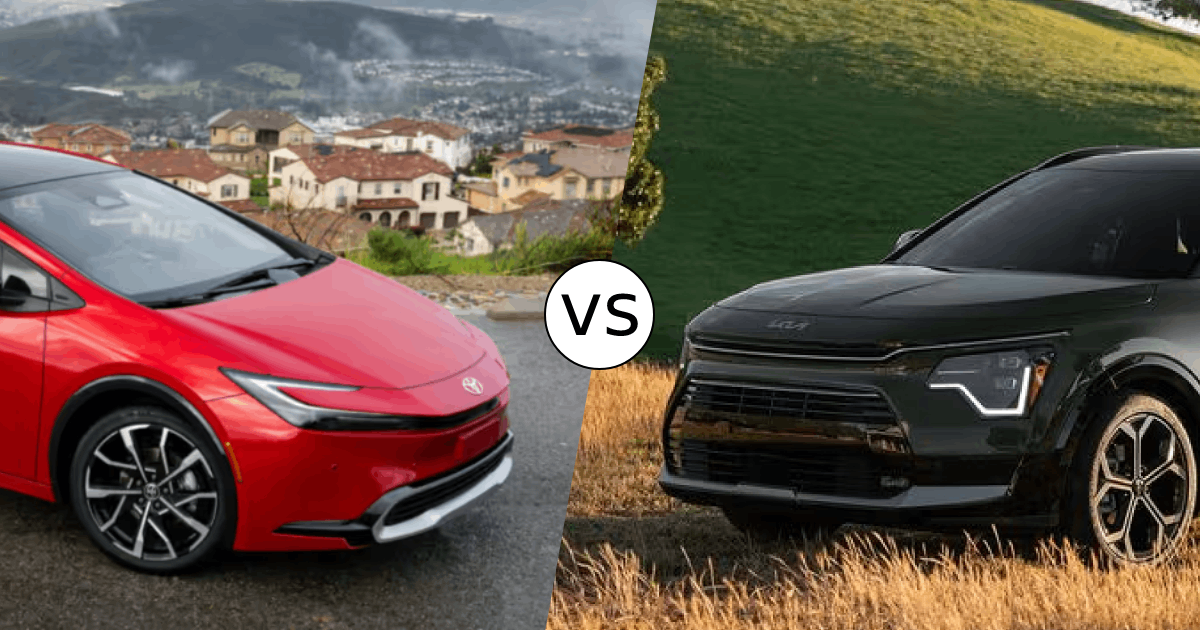
If you’re shopping for a hybrid, you’ve probably narrowed it down to two standout choices: the 2025 Toyota Prius and the Kia Niro. Both cars deliver solid fuel efficiency and eco-friendly driving, but they couldn’t be more different in their approach. One prioritizes maximum fuel economy and advanced hybrid tech, while the other focuses on practical crossover utility and family-friendly space. Our Longo Toyota team has broken down the details of both vehicles’ design, performance, safety, and value so you can figure out which hybrid works best for your El Monte life.
Design and Interior Features
These two hybrids take opposite design approaches. Toyota’s 2025 Prius has a bold, aerodynamic look with sharp angles and futuristic styling. It’s all about slicing through the air for maximum efficiency, even if that means looking a bit unconventional. Meanwhile, Kia’s Niro plays it safe with mainstream crossover appeal. The Prius turns heads at every stoplight, while the Niro blends right into suburban driveways.
A look inside the cabins tells you which automaker prioritizes what. The Kia has 105.1 cubic feet of passenger volume compared to the Prius’ 91.2 cubic feet. Your back seat passengers will appreciate the Niro’s generous 39.8 inches of legroom vs. the Prius’ 34.8 inches. Front seat riders get a slight edge in the Prius, though, with 43.2 inches of legroom. Toyota provides 38 inches of front headroom, while rear passengers get 36.4 inches, which works fine for most adults.
Kia’s Niro offers 22.8 cubic feet behind the rear seats, expanding to 63.7 cubic feet with seats folded. The standard Prius gives you 23.8 cubic feet, while the Prius Plug-In Hybrid (formerly known as the Prius Prime) drops to just 20.3 cubic feet behind rear seats, expanding to 26.7 cubic feet with seats down.
Both hybrids keep up with modern demands; Kia’s dual 10.25-inch screens for the instrument cluster and touch screen come with five USB ports and wireless device charging. Toyota counters with an 8-inch standard touch screen (12.3-inch available, standard on the Limited trim), plus six USB-C ports and wireless Android Auto/Apple CarPlay.
Performance and Efficiency
Power and acceleration reveal different automotive philosophies. Toyota’s 2025 Prius has a 2.0-liter four-cylinder engine delivering from 194 to 220 hp, depending on which version you choose, with 139 lb-ft of torque and quick 0-to-60 mph times of 6.6 to 7.2 seconds. This acceleration is necessary when merging onto Los Angeles County freeways. Kia’s standard Niro hybrid uses a smaller 1.6-liter four-cylinder paired with an electric motor for 139 horsepower total, hitting 0 to 60 mph in a leisurely 8.9 seconds. The plug-in hybrid version produces 180 hp with 195 lb-ft of torque.
Fuel economy is where the Prius dominates. Toyota’s regular 2025 Prius hybrid achieves 57 mpg city/56 mpg highway/57 mpg combined, and its Prius Plug-In Hybrid delivers 220 hp while returning up to 127 MPGe in electric/hybrid mode and 48 to 52 mpg in gas/hybrid mode. Kia’s regular hybrid manages 53 mpg city/45 mpg highway/49 mpg combined, while the plug-in gets 53 to 54 combined mpg.
The Prius also wins on electric-only driving capabilities. Toyota’s Prius plug-in hybrid version can travel up to 44 miles on electric power, with other models getting 40 miles of electric range. Kia’s plug-in hybrid offers 32 to 33 miles of electric-only range, still useful for short commutes around El Monte but noticeably less than the Prius. Charging times differ: the Toyota takes four hours with Level 2 charging or 11 hours with standard household charging, while Kia offers faster two- to three-hour Level 2 charging.
Safety and Reliability
Safety awards and ratings favor Toyota in this Prius vs. Kia Niro matchup. The Prius won the Insurance Institute of Highway Safety’s (IIHS) Top Safety Pick+ award for 2025, and the National Highway Traffic Safety Administration (NHTSA) gave the Prius Plug-In Hybrid a five-star overall safety rating. The Prius Plug-in Hybrid averaged five out of five stars from the NHTSA compared to the Kia Niro’s 4.28 out of five stars. While Kia also received a five-star overall rating from NHTSA, the lower average suggests Toyota performs more consistently across all testing categories.
Both cars come with abundant modern safety features, though they’re bundled differently. Kia’s Niro includes auto emergency braking with pedestrian and cyclist detection, blind-spot collision warning, rear cross-traffic collision-avoidance assist, lane-keeping and lane-following assist, and highway-driving assist as standard equipment. It also comes with pedestrian detection, blind-spot monitoring, and rear cross-traffic alert. Toyota matches these capabilities while delivering the superior overall safety performance reflected in those higher ratings.
Reliability and warranty coverage create an interesting trade-off between proven history and extensive protection. Toyota’s legendary reliability reputation is backed up by real data — the Prius Prime earned an 8.1 out of 10 quality rating from iSeeCars compared to the Niro’s 7.4 out of 10.
Kia’s warranty protection is good; it offers a five-year/60,000-mile basic warranty and a 10-year/100,000-mile powertrain warranty, while Toyota provides a three-year/36,000-mile basic warranty and a five-year/60,000-mile powertrain warranty. Hybrid-related components that require repairs needed to correct defects in materials or workmanship are covered for eight years/100,000 miles.
Which Hybrid Fits Your California Lifestyle?
The winner of the 2025 Kia Niro vs. the Toyota Prius showdown depends on what matters most to you. The Prius excels for efficiency-focused commuters who want maximum fuel economy, quicker acceleration, and longer electric driving range. Its 57-mpg combined rating and 40- to 44-mile electric range make perfect sense for daily San Gabriel Valley commuters who prioritize operating costs and environmental impact.
The IIHS Top Safety Pick+ award and stronger reliability ratings add extra peace of mind for long-term ownership. But families needing more passenger space and cargo capacity may prefer the Niro’s 105 cubic feet of passenger volume and 63.7 cubic feet of maximum cargo space.
Value considerations reveal interesting trade-offs between initial costs and long-term ownership. Toyota’s base 2025 Prius starts at $28,350 MSRP for the regular hybrid; the Plug-In Hybrid SE costs around $33,375 MSRP. Kia’s 2025 Niro starts at $26,990 MSRP, while the plug-in hybrid begins at $34,490 MSRP, slightly less expensive than Toyota’s plug-in model. However, depreciation patterns strongly favor Toyota: over five years, the Niro loses 40.4% of its value while the Prius loses just 31.1%, potentially saving you thousands in resale value.
Test-Drive a Prius at Longo Toyota Today
If you’re in the market for the best overall hybrid experience, the 2025 Toyota Prius delivers great value through its unmatched fuel economy, stronger safety ratings, better acceleration, and superior resale value. Are you curious about how the Prius handles? Try our virtual test-drive tool, or use our convenient online contact form to schedule a visit and an in-person test-drive through El Monte. Our friendly staff is ready to provide expert guidance on choosing the right Toyota hybrid.
Connect with us


- February 2026
- January 2026
- December 2025
- November 2025
- October 2025
- September 2025
- August 2025
- July 2025
- June 2025
- May 2025
- April 2025
- March 2025
- February 2025
- January 2025
- December 2024
- November 2024
- October 2024
- September 2024
- August 2024
- July 2024
- June 2024
- May 2024
- April 2024
- March 2024
- February 2024
- January 2024
- December 2023
- November 2023
- October 2023
- September 2023
- August 2023
- July 2023
- June 2023
- May 2023
- April 2023
- March 2023
- February 2023
- January 2023
- December 2022
- November 2022
- October 2022
- September 2022
- August 2022
- July 2022
- June 2022
- May 2022
- April 2022