


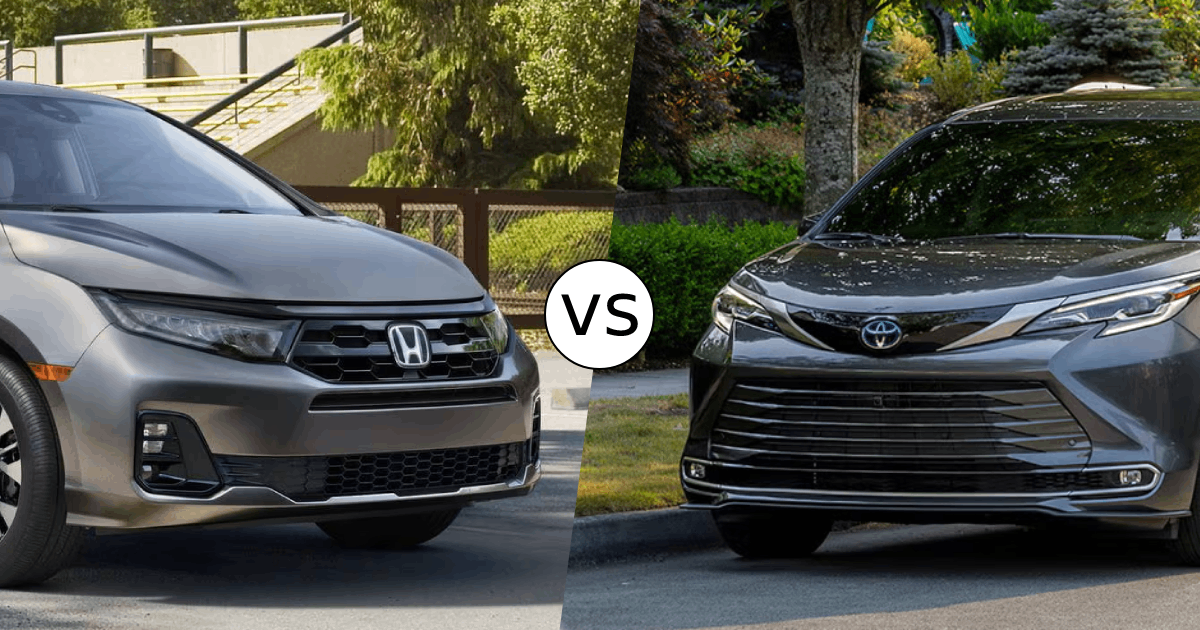
If you’re shopping for a family minivan, you’ll want to check out the biggest players in the market: the 2025 Toyota Sienna and the 2025 Honda Odyssey. Each model shines in different areas. The Sienna offers impressive fuel savings, while the Odyssey has superior cargo space. To figure out which minivan is right for your family, the Honda Odyssey vs. the Toyota Sienna, join our team at Longo Toyota in El Monte, California, as we dig into what makes each model tick.
Pricing and Value
The Odyssey comes in four trims with a range of starting MSRPs:
- EX-L: $42,795
- Sport: $43,895
- Touring: $47,495
- Elite: $51,695
The Sienna offers six trims:
- LE: $39,485
- XLE: $44,295
- XSE: $46,940
- Limited: $50,500
- Woodland Edition: $50,725
- Platinum: $56,445
The Sienna’s and the Odyssey’s price ranges are largely similar, but with a nearly $5,000 difference between their top trims, Honda’s best is about 10% cheaper. For more savings, Honda also sweetens the deal with $500 back for existing owners, as well as exclusive lease deals.
However, there’s more to consider than just the ticket price. You need to think long-term too. Kelley Blue Book ranked the Toyota Sienna in seventh place for best resale value for minivans. It also named Toyota as the best brand for resale value for the eighth time in nine years, demonstrating the automaker’s dedication to quality and value.
Performance and Efficiency
The Honda Odyssey uses a 3.5-liter V-6 that outputs 280 horsepower. With a 6.4-second 0-to-60 mph sprint time, the Odyssey is responsive at red lights. The hybrid Toyota Sienna pairs a 2.5-liter four-cylinder with an electric motor, producing 245 horsepower. With a 7.5-second 0-to-60 sprint time, the Sienna isn’t as fast off the line as the Odyssey. Both vans can tow up to 3,500 pounds, enough for a small camper or Jet Ski.
When it comes to gas mileage, the Sienna is miles ahead of the Odyssey. The front-wheel-drive model gets 36 mpg in both the city and on the highway, while all-wheel-drive (AWD) models get 34 mpg city and 36 mpg highway. The Odyssey is much less efficient, only getting 19 mpg city and 28 mpg highway. That translates to about $500-$750 saved yearly on gas with the Sienna, depending on how much you drive and your local prices.
Toyota also offers AWD, which Honda doesn’t. If you live somewhere snowy or wet, that can be a significant deciding factor. The Sienna sips fuel like a compact car while handling winter roads like an SUV.
Interior Features and Passenger Comfort
Both minivans can hold eight passengers, but they offer different seating and storage configurations. Honda’s Magic Slide second-row seats are brilliant engineering — slide them sideways for easier third-row access, tilt them forward, or remove them completely for massive hauling space. Every Odyssey includes heated front seats standard, which is ideal for chilly morning school runs. To compare, Toyota’s second-row seats are bolted in place, making it a less versatile option, especially if you regularly haul sports gear or large furniture.
For interior dimensions, the Sienna and the Odyssey are evenly matched, with less than an inch difference in leg and headroom. The Honda has slightly more legroom in the first and second rows with 40.9 inches, while the Sienna has a bit more room in the third row with 38.7 inches. The Toyota also has more headroom in the first and second rows, but the Honda is barely taller in the third row.
For cargo capacity, the Honda Odyssey absolutely dominates. Behind the third row, the Odyssey has 32.8 cubic feet, while the Sienna has 33.5 cubic feet, making them nearly identical for daily grocery runs. However, fold that third row down, and the Honda jumps to 86.6 cubic feet versus Toyota’s 75.2. The Sienna maxes out at 101 cubic feet. The Odyssey is cavernous by comparison, with up to 155.8 cubic feet of space with all the seats down — that’s a 44 cubic foot difference.
Safety and Reliability
Both vans have your back with top-tier safety features. They’ve each earned Top Safety Pick awards from the Insurance Institute for Highway Safety. Honda edges ahead with a 9.0/10 U.S. News safety score and perfect five-star National Highway Traffic Safety Administration crash ratings. Toyota’s not far behind at 8.9/10. Overall, you can’t go wrong with either van when it comes to protecting your family. Both pack similar tech such as forward collision warning, lane-keep assist, and driver-fatigue systems.
For warranty coverage, J.D. Power gives Honda a tiny lead — 77/100 versus Toyota’s 76/100. However, Toyota offers a massive 10-year/150,000-mile warranty for the hybrid battery. That’s serious peace of mind Honda can’t match with its traditional powertrain. Both brands stand behind their vans with solid warranties, but Toyota goes the extra mile by covering those expensive hybrid components for the long haul. When you’re talking about buying a family vehicle that’ll last the next decade, that warranty difference matters.
Design and Exterior Features
The 2025 Odyssey’s refreshed aesthetic includes a new grille, reshaped bumpers, and fresh 18/19-inch wheels. It comes in seven paint options: Crystal Black Pearl, Modern Steel Metallic, Smoke Blue Pearl, Solar Silver Metallic, Platinum White Pearl, Radiant Red Metallic II, and Sonic Gray Pearl. Overall, the Odyssey is practical but stylish.
The Toyota Sienna’s design direction is much bolder, shaking off the soccer-parent reputation of older minivans. It turns heads with a wide grille and thin Bi-LED headlights, exclusive 20-inch machined-finish alloy wheels, and upscale chrome accents. If Honda is business casual, Toyota is weekend warrior chic.
The Odyssey stretches 205.2 inches long, 78.5 inches wide, 69.6 inches tall, making it 1.5 inches longer and 1.1 inches taller than the Sienna. Yet despite being physically bigger, it also weighs 135 pounds less than the hybrid Sienna. This size advantage directly translates to the Odyssey’s extra interior room and cargo capacity, while the Sienna’s more compact footprint helps with tight parking spots and contributes to better fuel economy.
Which Minivan Wins Your Family’s Heart?
Edmunds rated the Sienna at 8.3/10 versus the Odyssey’s 8.1/10. The Sienna won points for clever small-item storage solutions and its exclusive AWD option, while the Odyssey scored high marks for flexible seating arrangements and overall passenger comfort. When comparing the Odyssey vs. the Sienna, both are excellent choices. It mostly depends on your family’s priorities. If you want to check out the Sienna for yourself, visit us at Longo Toyota for a test-drive. Our team is here to show you why the Sienna will make a great family hauler for years to come.
Connect with us


- February 2026
- January 2026
- December 2025
- November 2025
- October 2025
- September 2025
- August 2025
- July 2025
- June 2025
- May 2025
- April 2025
- March 2025
- February 2025
- January 2025
- December 2024
- November 2024
- October 2024
- September 2024
- August 2024
- July 2024
- June 2024
- May 2024
- April 2024
- March 2024
- February 2024
- January 2024
- December 2023
- November 2023
- October 2023
- September 2023
- August 2023
- July 2023
- June 2023
- May 2023
- April 2023
- March 2023
- February 2023
- January 2023
- December 2022
- November 2022
- October 2022
- September 2022
- August 2022
- July 2022
- June 2022
- May 2022
- April 2022