


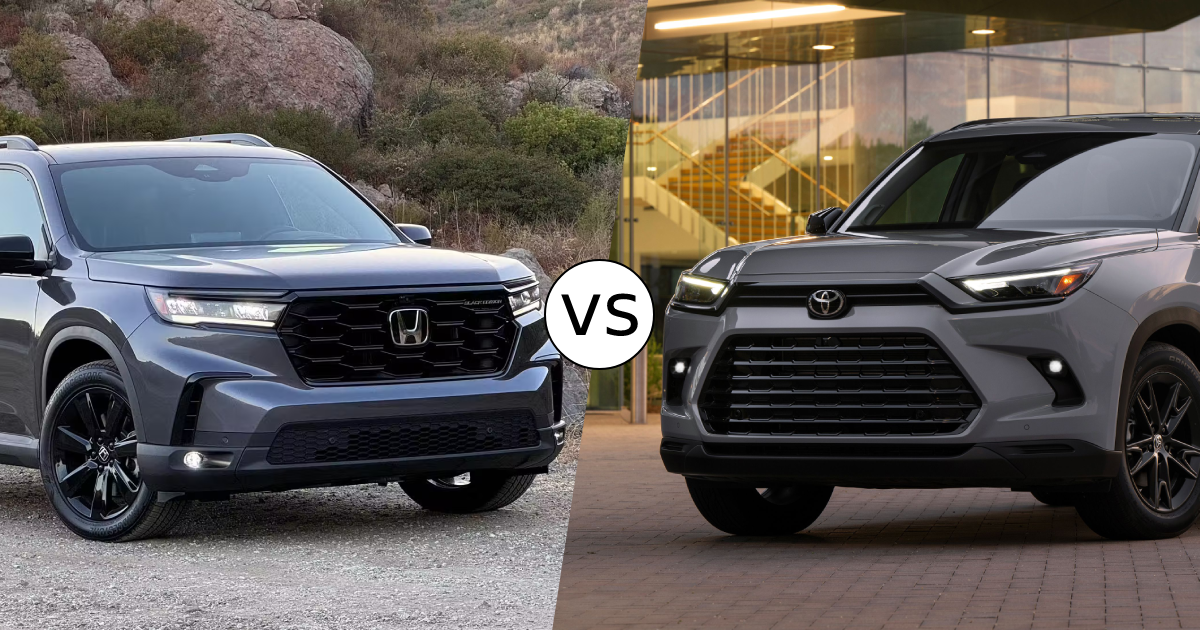
Family-friendly and capable, the 2025 Toyota Grand Highlander and the 2025 Honda Pilot are duking it out for dominance in the three-row SUV market. Both offer roomy interiors and impressive safety tech, but they’re not carbon copies of each other. At Longo Toyota in El Monte, California, we’ll guide you through the 2025 Toyota Grand Highlander vs. Honda Pilot comparison to help you figure out which one fits your life better.
If you’re looking to test-drive the new 2025 Toyota Grand Highlander, give our team a call at 626-539-2113.
Pricing and Value
The 2025 Toyota Grand Highlander has a starting price of $40,860 for its base LE trim. Honda’s Pilot begins just a bit lower at $40,200 for the Sport trim. That $660 difference might matter if you’re pinching pennies, but smart shoppers look beyond the up-front cost.
Toyota scores major points with its two-year/25,000-mile free scheduled maintenance program, and the Grand Highlander’s strong resale value sweetens the deal. Honda makes a solid product, but the company doesn’t match Toyota’s maintenance perk, which could leave a few hundred extra bucks in your pocket during those first couple of ownership years.
Performance and Efficiency
Each of these vehicles presents its own approach to performance.
Engine and Transmission Details
Toyota offers many engine choices. The Grand Highlander’s base powerplant is a zippy 265-horsepower turbocharged 2.4-liter four-cylinder engine pairing with an eight-speed automatic transmission. Hybrid options include a powertrain that combines a 2.5-liter engine with electric motors for 245 horsepower. The Hybrid MAX Limited trim marries a turbo 2.4-liter with an electric boost for a hefty 362 horsepower and 400 lb-ft of torque. Car and Driver clocked the nonhybrid Grand Highlander reaching 60 mph from a standstill in 7 seconds.
Honda keeps it simple with one choice across all Pilot trims: a 285-horsepower 3.5-liter V-6 engine hooked to a 10-speed automatic transmission. It’s a solid performer, but you won’t find any fuel-sipping hybrid tech here.
Fuel Economy and Range
If fill-ups are destroying your budget, the Grand Highlander’s hybrid models might be your saving grace. The standard hybrid variant delivers 37 mpg city, 34 mpg highway, and 36 mpg combined with front-wheel drive. Even the muscle-bound Hybrid MAX Limited manages a respectable 26 mpg city/27 mpg highway/27 mpg combined with all-wheel drive. The nonhybrid version still posts decent figures of 21 mpg city and 28 mpg highway.
Honda’s V-6-only Pilot can’t touch those hybrid figures — you’ll get 19 mpg city and 27 mpg highway with front-wheel drive. It even struggles against the Grand Highlander’s nonhybrids; Car and Driver saw them hitting 29 mpg during their 75-mph highway test loop. Your wallet will thank you for those fewer stops at the gas pump with the Toyota.
Interior and Comfort
There’s much to compare inside the Toyota Grand Highlander and the Honda Pilot.
Seating Capacity and Passenger Space
Both SUVs offer seven- or eight-passenger flexibility. The Grand Highlander has captain’s chairs as standard in row two, making it a seven seater. Toyota will swap in a bench seat at no cost if you need that extra spot. Honda follows a similar playbook with captain’s chairs on fancier trims.
Third-row comfort is where things get interesting. An inch might not sound like much, but the Grand Highlander’s 33.5 inches of third-row legroom against the Pilot’s 32.5 inches makes a real difference. Ask any teenager or adult banished to the back — that extra space matters on long trips. Toyota’s bigger dimensions produce a roomier feel throughout the cabin.
Cargo Space and Versatility
Behind the Grand Highlander’s third row, you’ll find 20.6 cubic feet of space, outstripping the Pilot’s 18.6. Drop that third row, and the Toyota offers 57.9 cubic feet against the Honda’s 48.5. Fold everything flat, and the Grand Highlander swallows a massive 97.6 cubic feet of stuff, soundly beating the Pilot’s 87 cubic feet.
This extra space is three more suitcases on your family vacation or that bulky furniture purchase that fits without renting a truck. Both SUVs give you power liftgates and seats that fold flat easily, but families who haul lots of gear can’t ignore the Grand Highlander’s sheer volume advantage.
Interior Quality and Features
If you’re a tech fan, you’ll love the Grand Highlander’s standard 12.3-inch touch screen, significantly bigger than the 9-inch display in top Pilot trims. Toyota also offers an optional 12.3-inch digital gauge cluster that looks like it belongs in a luxury car. Both SUVs connect with your phone through wireless Apple CarPlay and Android Auto.
Music lovers can rock to the Grand Highlander’s optional 11-speaker JBL premium audio setup. The available panoramic moonroof floods the cabin with natural light, making the interior feel even roomier. Both vehicles offer wireless phone charging pads, but the Grand Highlander’s bigger standard screen and that gorgeous digital dash option give it the edge in the tech department.
Safety and Reliability
Safety is paramount for family haulers, and both manufacturers deliver solid protection. The Grand Highlander boasts Toyota Safety Sense 3.0, which includes adaptive cruise control, lane trace assist, and auto high beams. Honda counters with its own Honda Sensing suite offering comparable features.
Toyota backs the Grand Highlander with a standard three-year/36,000-mile basic warranty and five-year/60,000-mile powertrain coverage. This may not seem exceptional, but don’t forget that free maintenance program. Both brands have built their reputations on making vehicles that last forever, so you’ll likely pass either SUV down to your teenager before any significant issues arise.
Road Handling and Driving Experience
Neither of these family haulers will be carving canyon roads like sports cars, but they handle themselves with dignity. On Car and Driver’s skid pad test, the Pilot achieved a slightly better grip of 0.84 g against the Grand Highlander’s 0.80 g. The Pilot’s edge might matter if you regularly tackle winding roads. The Grand Highlander stopped from 70 mph in 184 feet during testing, a solid performance for a vehicle of its size.
Your daily driving experience will depend on which Grand Highlander powerplant you choose. The base turbo engine handles everyday tasks efficiently, while the hybrids deliver that smooth, quiet ride with instant electric torque. Opt for the Hybrid MAX Limited if you want surprising pep from your family SUV. Although the Pilot delivers consistent V-6 grunt across all trims, you’ll miss out on the quiet efficiency of the Grand Highlander hybrids.
Which SUV Reigns Supreme?
In the Honda Pilot vs. Toyota Grand Highlander debate, we observe that both are solid family SUVs that cater to different priorities. The Grand Highlander wins on space, cargo room, and — especially with the hybrids — fuel economy. You also get a bigger standard infotainment screen and free maintenance for two years. The Honda Pilot may counter with sportier handling and the simplicity of a proven V-6 powertrain across all versions, but it’s not enough to push the Toyota Grand Highlander off top spot.
Test-Drive the Toyota Grand Highlander Today
If you’re curious about the 2025 Grand Highlander, visit our Longo Toyota dealership in El Monte, California. Our knowledgeable team will answer any questions and guide you through the vehicle’s many features. To be sure the Toyota Grand Highlander is the right fit for your family’s adventures, contact us today to book a test-drive.
Connect with us


- February 2026
- January 2026
- December 2025
- November 2025
- October 2025
- September 2025
- August 2025
- July 2025
- June 2025
- May 2025
- April 2025
- March 2025
- February 2025
- January 2025
- December 2024
- November 2024
- October 2024
- September 2024
- August 2024
- July 2024
- June 2024
- May 2024
- April 2024
- March 2024
- February 2024
- January 2024
- December 2023
- November 2023
- October 2023
- September 2023
- August 2023
- July 2023
- June 2023
- May 2023
- April 2023
- March 2023
- February 2023
- January 2023
- December 2022
- November 2022
- October 2022
- September 2022
- August 2022
- July 2022
- June 2022
- May 2022
- April 2022