


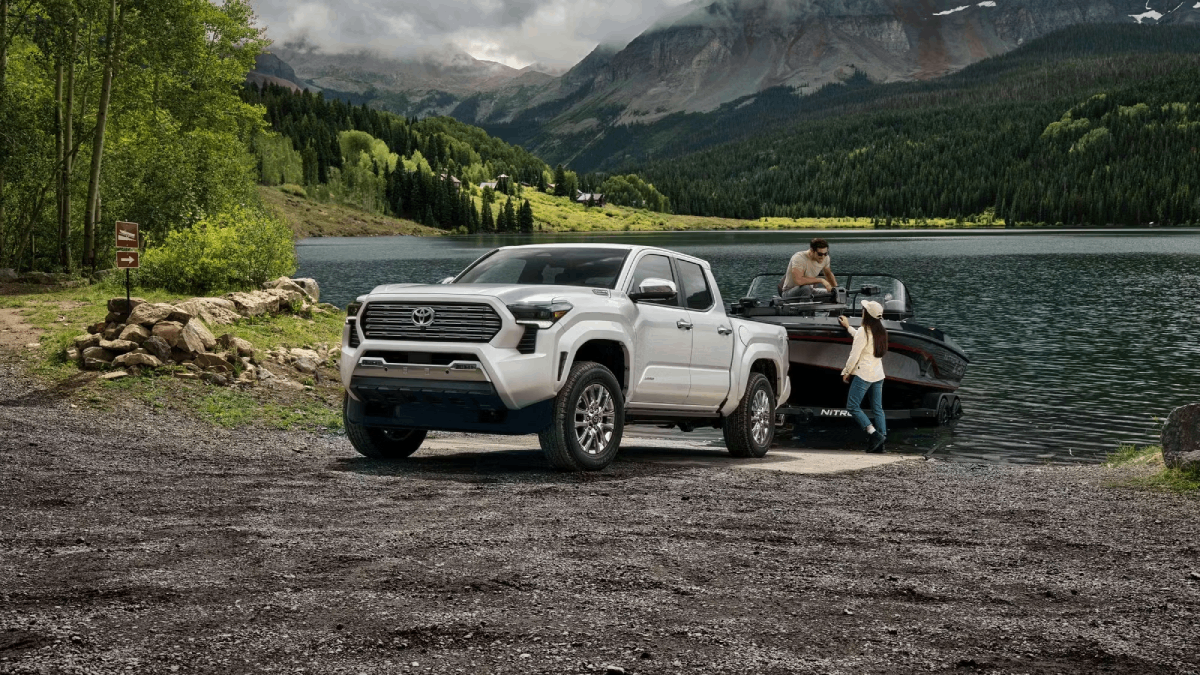
Picking the right truck for towing comes down to understanding exactly what your vehicle can handle and how to use it safely. The 2026 Toyota Tacoma delivers solid towing technology to the midsize truck segment, mixing power with smart engineering and driver-assist features that make hauling trailers easier. Whether you’re heading to Big Bear for weekend camping adventures with a travel trailer or need to haul work equipment around Southern California, knowing your Tacoma’s specs and following good practices will let you tow with real confidence.
At Longo Toyota, we help El Monte area drivers match the right Tacoma configuration to their actual towing needs, from recreational hauling to work applications.
2026 Toyota Tacoma Towing Capacity Overview
The 2026 Toyota Tacoma towing capacity ranges from 3,500 to 6,500 pounds, based on how you configure it. This gives you room to match your truck to what you actually need to haul. Your real towing capacity depends on several key factors: which engine you choose, cab style, bed length, and whether you go with two-wheel or four-wheel drive.
Which trim you pick makes a significant difference in maximum capability. Base models handle lighter loads, while properly equipped higher trims hit the maximum towing capacity the Tacoma offers. Here’s how the powertrains and trims compare:
Powertrain Comparison:
| Powertrain | Max Towing | Horsepower | Torque | Transmission |
| i-FORCE 2.4L Turbo | Up to 6,500 lbs | 278 hp (228 hp SR) | 317 lb-ft | 8-speed auto or 6-speed manual |
| i-FORCE MAX Hybrid | Up to 6,000 lbs | 326 hp | 465 lb-ft | 8-speed automatic |
Trim-Level Towing Capacities:
| Trim | Maximum Towing Capacity |
| SR (Automatic) | Up to 3,500 lbs |
| SR (6-Speed Manual) | Up to 6,400 lbs |
| SR5 | Up to 6,500 lbs |
| TRD PreRunner | Up to 6,500 lbs |
| TRD Sport | Up to 6,400 lbs |
| TRD Off-Road | Up to 6,400 lbs |
| Limited | Up to 6,300 lbs |
| TRD Sport i-FORCE MAX | Up to 6,000 lbs |
i-FORCE Turbo vs. i-FORCE MAX Hybrid Powertrains
The i-FORCE turbo engine delivers strong horsepower and torque, making it a reliable choice for drivers who need dependable towing power. This turbocharged four-cylinder maintains power throughout the towing range, so you’ll feel confident merging onto highways or climbing mountain passes with a trailer in tow.
The i-FORCE MAX hybrid adds electric motor support to that turbocharged engine, creating 465 lb-ft of torque. This setup provides extra torque at lower speeds, which helps when starting from a stop with a heavy load or tackling steep grades. The hybrid also maintains better fuel efficiency while towing.
Both engines pair with the Toyota Tacoma tow package, which includes transmission cooling, upgraded suspension components, and integrated trailer brake controllers. Your choice between these powertrains comes down to what kind of towing you’ll do most and whether the hybrid’s low-end torque boost fits your typical driving situations.
Step 1: Preparing Your Tacoma Before You Tow
Good preparation makes the difference between smooth towing and a stressful trip. Before hitching up, check tire pressure on both truck and trailer to match manufacturer specifications. You’ll find the correct pressure for your truck on the door jamb sticker. Test all trailer lights (brake lights, turn signals, running lights) to confirm everything works.
Check your hitch receiver for wear, rust, or damage. The hitch rating must match or exceed your trailer’s tongue weight and total weight. Verify that your ball mount is at the correct height to keep your trailer level when connected.
Activating Tow/Haul Mode and Trailer Settings
Tow/Haul mode changes how your Tacoma’s transmission responds to the gas pedal and handles gear changes. It adjusts shift points to keep the engine in its power band longer, reducing shifts during acceleration and providing better engine braking on downhills. The Tow/Haul button is located on the dashboard or shift selector.
Setting up trailer details through the Multi-Information Display helps your truck’s systems understand what you’re pulling. Enter your trailer length and weight so features like Trailer-Sway Control can work effectively. This setup also helps the Trailer Backup Guide provide accurate guidance lines when reversing.
Understanding Your Specific Towing Limits
Your Tacoma’s door jamb sticker shows the weight ratings that determine safe towing limits. The Gross Combined Weight Rating (GCWR) is the maximum weight of your loaded truck plus loaded trailer combined. Take your truck’s actual weight (with passengers and cargo) and subtract it from the GCWR to find what you can actually tow.
Tongue weight should typically run between 10 and 15 percent of your trailer’s total weight. Getting this balance right prevents trailer sway. The Toyota Tacoma offers maximum payload of 1,705 lbs (non-hybrid) or 1,710 lbs (hybrid). Remember that passengers and cargo in the truck bed reduce your available trailer weight. The Tacoma includes bed options of 5-foot or 6-foot SMC (Sheet-Molded Composite), with an optional 2400W AC power supply available.
Step 2: Hitching Up With Tacoma’s Camera Technology
Camera systems take most of the hassle out of hitching up. Your Tacoma’s rearview camera provides a clear view of the hitch ball and trailer coupler, so you can line them up without assistance. The available bird’s-eye view creates a virtual overhead perspective, showing your truck’s position relative to the trailer from multiple angles.
The Trailer Backup Guide with Straight Path Assist displays dynamic guidelines on screen that move as you turn the steering wheel, showing where you’re actually headed. This helps when backing up to a trailer on uneven ground or in tight spots. Once you’ve positioned the coupler onto the ball, step out and verify the connection is secure before locking the latch and hooking up safety chains.
Cross your safety chains under the trailer tongue in an X pattern. Leave enough slack for turns but don’t let them drag on the ground. Plug the trailer’s electrical connector into your truck’s socket, then test all lights again. Connect the breakaway cable to a secure spot on your hitch that’s separate from the ball mount.
The Extended Blind Spot Monitor (BSM) automatically detects trailer presence and expands its detection zone to cover your trailer’s length, providing extra safety when changing lanes.
Step 3: Loading and Weight Distribution Essentials
Smart loading creates stable, controlled towing. Put 60 percent of your cargo weight in the front half of the trailer, ahead of the axles. This forward weight creates proper tongue weight while preventing the trailer from becoming tail-heavy, which causes dangerous swaying.
Secure everything using ratchet straps or cargo nets so nothing shifts during the drive. Even small movements of loose items can affect your trailer’s balance, especially during emergency maneuvers or quick stops. Place heavy items low and centered, while lighter gear can sit higher or farther from the centerline.
Weight distribution hitches become beneficial when your loaded trailer tongue weight exceeds what your truck’s rear axle can handle comfortably. These systems use spring bars to transfer some weight forward onto the truck’s front axle and back onto the trailer’s axles, resulting in a level stance that improves steering and braking.
Step 4: Driving While Towing With Tacoma’s Safety Systems
Towing changes how your truck drives in ways that require attention and adjustment. Your stopping distance increases significantly with a trailer, so maintain extra distance from vehicles ahead. Plan lane changes well in advance, using mirrors to account for your trailer’s length.
The Tacoma’s safety systems continue working while you tow, with some adjusting their sensitivity based on your trailer settings. The Pre-Collision System monitors the road ahead and can apply brakes if it detects a potential crash. The expanded Blind Spot Monitor tracks vehicles alongside your extended length when trailer dimensions are entered.
Trailer Sway Control and Stability Features
Trailer sway occurs when your trailer rocks side to side, creating a dangerous situation. The Tacoma’s Trailer-Sway Control constantly monitors movement through sensors that detect unexpected sideways motion. When sway starts, the system applies brakes to specific wheels strategically, helping straighten everything out.
This happens automatically, often before you’d notice the problem starting. Strong crosswinds (common when heading to coastal areas or through desert passes near El Monte), passing large trucks, or rough road surfaces can trigger sway, but the stability system fights back. The system works with Vehicle Stability Control and the 4×4 drivetrain, along with ABS (Antilock Braking System) with Electronic Brake-force Distribution for comprehensive towing stability.
Braking and Handling Techniques
Smooth, gradual braking becomes essential when towing. Start slowing earlier than you would without a trailer, using steady pressure instead of sudden hard stops. Your trailer’s brakes should activate simultaneously with your truck’s brakes through the integrated controller.
Downhill sections need special attention. Shift to a lower gear before descending steep hills, letting engine braking control your speed rather than riding the brakes. This prevents brake fade, which happens when brakes overheat from constant use. Tow/Haul mode increases engine braking automatically, but manually selecting a lower gear provides even more control on steep descents.
Corners require wider turns and slower speeds than usual. Your trailer wheels track inside your truck’s path, so you need to swing out more before turning to avoid curbs or obstacles.
What Can Your Toyota Tacoma Tow?
Knowing what your Toyota Tacoma can tow helps you plan trips and work projects with confidence. Here are common trailer types within the Tacoma’s capability:
- Small to mid-size travel trailers up to 6,500 lbs (typically 20 to 25 feet long with beds, kitchenettes, and bathrooms)
- Mid-size fishing boats with trailers (3,500 to 5,000 lbs combined weight)
- Single-axle utility trailers carrying landscaping gear, ATVs, or construction tools
- Enclosed snowmobile or ATV trailers for recreational trips
- Personal watercraft and dirt bike trailers
- Equipment trailers for small businesses hauling lawn care equipment, contractor tools, or event gear
Remember to count the weight of cargo in your truck bed when calculating available trailer weight, since they work against the same total rating. Always consult your owner’s manual for your specific vehicle configuration and California towing regulations regarding proper licensing and weight limits.
Explore Tacoma Towing Technology at Longo Toyota
We invite you to experience the 2026 Tacoma’s towing features firsthand at Longo Toyota. Our team can help you determine which trim level and tow package best fits your specific hauling needs, whether you’re planning recreational adventures or need a capable work truck.
Browse our new vehicles inventory to explore available trims and configurations, or take a virtual test drive to experience the Tacoma’s capabilities. Located at 3534 North Peck Road in El Monte, our service center handles everything from routine maintenance to towing system checkups, keeping your Tacoma ready for any hauling task. Contact our sales team at 626-539-2113 or visit our contact page to schedule a personalized consultation about your towing needs.
Connect with us


- March 2026
- February 2026
- January 2026
- December 2025
- November 2025
- October 2025
- September 2025
- August 2025
- July 2025
- June 2025
- May 2025
- April 2025
- March 2025
- February 2025
- January 2025
- December 2024
- November 2024
- October 2024
- September 2024
- August 2024
- July 2024
- June 2024
- May 2024
- April 2024
- March 2024
- February 2024
- January 2024
- December 2023
- November 2023
- October 2023
- September 2023
- August 2023
- July 2023
- June 2023
- May 2023
- April 2023
- March 2023
- February 2023
- January 2023
- December 2022
- November 2022
- October 2022
- September 2022
- August 2022
- July 2022
- June 2022
- May 2022
- April 2022