


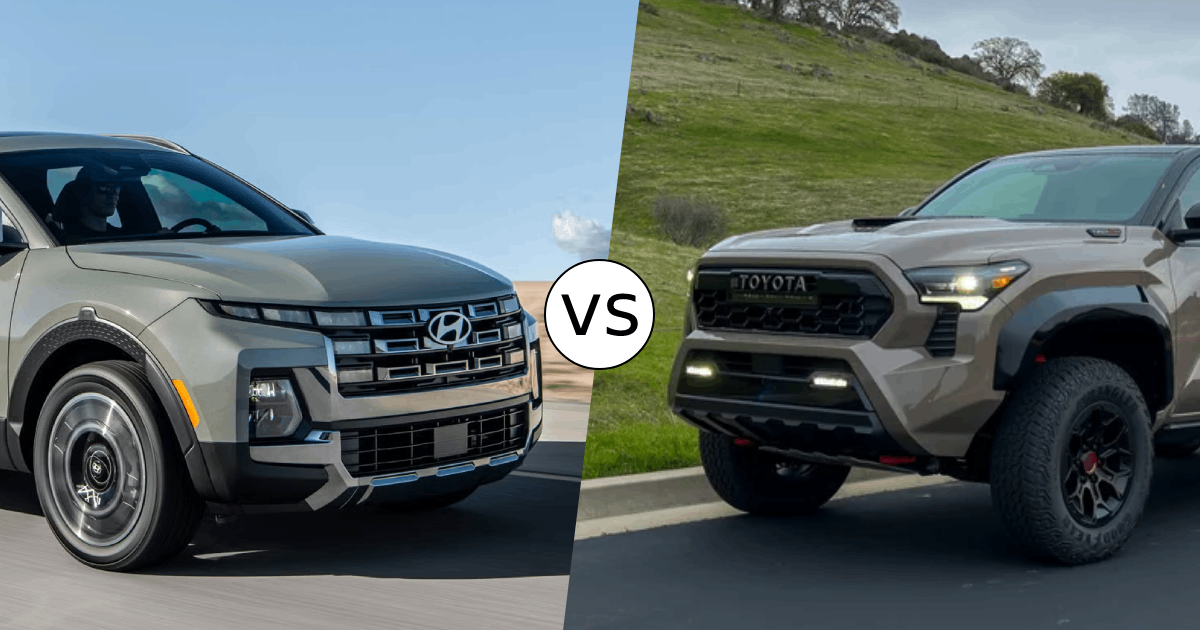
Choosing between a midsize truck and a crossover-truck hybrid sounds straightforward until you actually start digging into the details. The core tension here comes down to construction philosophy: the 2026 Toyota Tacoma is a body-on-frame truck engineered for serious capability, while the 2026 Hyundai Santa Cruz is a unibody crossover-truck built around comfort and convenience. That single distinction shapes everything from towing limits to trail performance to long-term durability.
Both vehicles have genuine strengths, but when the specs sit side by side, the Tacoma consistently pulls ahead for drivers who need real utility. Browse our 2026 Tacoma inventory at Longo Toyota and see the full lineup for yourself.
Two Different Trucks With Two Very Different Visions
At their core, these two vehicles represent genuinely different ideas about what a truck should be. The Tacoma is a traditional midsize pickup built around ruggedness, towing strength, and serious off-road capability. It appeals to drivers who actually use their trucks for truck things: hauling equipment, venturing off the beaten path, towing a boat on weekends across Southern California.
The Santa Cruz takes a different direction. Hyundai classifies it as a Sport Adventure Vehicle, a crossover-inspired platform that borrows some pickup truck DNA while staying firmly in daily driver territory. It’s comfortable, compact, and well-suited for urban environments. For buyers with serious utility needs, though, the comparison quickly reveals just how much separates these two.
2026 Toyota Tacoma vs. Hyundai Santa Cruz: Specs at a Glance
Here’s how the two vehicles compare across key performance categories:
| Specification | 2026 Toyota Tacoma | 2026 Hyundai Santa Cruz |
| Body Construction | Body-on-frame | Unibody |
| Engine Options | Turbo I-4 / Hybrid I-4 (i-FORCE MAX) | Naturally aspirated I-4 / Turbo I-4 |
| Horsepower | 228-278 hp (gas); 326 hp (hybrid) | 191 hp (base); 281 hp (turbo) |
| Towing Capacity (max) | 6,500 lbs (gas); 6,000 lbs (i-FORCE MAX hybrid) | 5,000 lbs (turbo) |
| Payload Capacity | Up to 1,705 lbs (gas); up to 1,710 lbs (hybrid) | 1,411 lbs |
| Ground Clearance | 9.4 in. (up to 11.5 in. TRD Pro) | 8.6 in. |
| Bed Length (max) | 73.5 in. (6-ft) | 52.1 in. (4.3-ft) |
| Drive Type | RWD standard; 4WD available | FWD standard; AWD available |
The Tacoma leads in towing, off-road hardware, engine performance, and bed size. The Santa Cruz offers a smoother ride and a more crossover-like daily driving experience, which genuinely suits some buyers. For drivers who need a truck to actually work like a truck, the specs make the case on their own.
Powertrain Options: More Power, More Choices With the Tacoma
Engine choice shapes how a vehicle performs under load, how it handles on the highway, and what you’ll spend at the pump over the years of ownership. The Tacoma offers significantly more variety and capability across its trim levels.
Tacoma’s Turbocharged and Hybrid Lineup
Toyota engineered the 2026 Tacoma around the i-FORCE turbocharged 2.4L I-4, producing 228 hp at 6,000 RPM and 243 lb-ft of torque at 1,600 RPM in the SR trim. Higher trims push those figures to 278 hp and 317 lb-ft. Then there’s the i-FORCE MAX hybrid variant, which pairs the turbocharged engine with an electric motor to produce 326 hp and 465 lb-ft of torque.
That combination delivers class-leading output while improving fuel efficiency in ways a conventional powertrain simply can’t match. An 8-speed automatic handles most trims, and a 6-speed manual stays available for drivers who prefer to row their own gears.
Santa Cruz Engine Options and Where They Fall Short
The Santa Cruz does offer a turbocharged 2.5L I-4 in upper trims, producing 281 hp and 311 lb-ft of torque. The base engine is a naturally aspirated 2.5L I-4 rated at 191 hp and 181 lb-ft. That turbo variant is a capable engine for daily commuting, but even at peak output, it trails the Tacoma’s hybrid numbers by a wide margin. For buyers who plan to tow regularly or carry heavy payloads, that gap is hard to ignore.
Towing and Payload Capacity: The Tacoma Pulls Ahead
The numbers tell a clear story. The 2026 Tacoma is rated to tow up to 6,500 lbs on gas-powered trims and up to 6,000 lbs on the i-FORCE MAX hybrid, while the Santa Cruz tops out at 5,000 lbs with its turbocharged engine. Payload capacity follows a similar pattern: the Tacoma carries up to 1,705 lbs on gas trims and up to 1,710 lbs on the hybrid, compared to a maximum of 1,411 lbs for the Santa Cruz.
For contractors, outdoor enthusiasts towing ATVs, or anyone regularly moving heavy cargo, the Tacoma’s advantage is real and practical. Toyota designed its frame, suspension, and powertrain with actual work in mind, not just the appearance of capability.
Off-Road Capability: Built for the Trail vs. Built for the Weekend
Once you leave paved roads, the difference between these two vehicles becomes even more obvious. The Tacoma comes with 9.4 inches of ground clearance in standard configuration, with the TRD Pro reaching up to 11.5 inches of running ground clearance when the suspension is fully articulated. The Santa Cruz offers 8.6 inches. Those numbers reflect a meaningful difference in what each vehicle can actually handle.
Tacoma TRD Off-Road and Trailhunter Configurations
Toyota offers dedicated off-road trims that turn the Tacoma into a genuine trail machine. The TRD Off-Road comes standard with a locking rear differential, crawl control, Multi-Terrain Select, skid plates, and suspension tuned specifically for rough terrain. The Trailhunter goes further, arriving from the factory with advanced suspension, underbody protection, and hardware built for sustained off-road use.
Whether you’re exploring Angeles National Forest trails or running fire roads in the San Gabriel Mountains, these configurations are mechanically ready before you ever touch a modification.
Santa Cruz Off-Road Limitations
The Santa Cruz offers AWD and handles light gravel roads or mild trails reasonably well. There’s no comparable off-road-specific trim in its lineup, though. Its unibody construction, which works beautifully for a smooth pavement ride, limits its ability to flex and absorb punishment on rougher terrain. The Santa Cruz is capable for casual weekend adventure, and it does that job well. It simply wasn’t built for the sustained off-road work the Tacoma handles as a baseline expectation.
Cargo Bed Utility and Real-World Hauling
Bed design is one of the most practical differences between these two trucks. The Tacoma’s bed reaches 73.5 inches in its 6-foot configuration, accommodates standard accessories like toolboxes and bed liners, and handles sustained weight without issue. The Santa Cruz offers a 52.1-inch bed (roughly 4.3 feet), which limits what can fit without folding the tailgate down.
Hyundai did include a clever underfloor storage bin that keeps smaller items dry and organized. It’s a useful feature, but it doesn’t compensate for reduced overall capacity. For real-world hauling, the Tacoma’s bed is simply more versatile.
Long-Term Value, Resale, and What the Future Holds
Resale value is one of the most underappreciated factors in any vehicle purchase, and this is where the Tacoma’s track record really stands out. The Tacoma consistently ranks among the highest-retained midsize trucks in the country, driven by its reliability reputation, a dedicated owner community, and steady demand for used units. Buyers who purchase a Tacoma today can reasonably expect a strong return when they eventually sell or trade in.
The Santa Cruz entered the market in 2022 and hasn’t yet built the same depth of resale history. It’s a genuine innovation in its segment. Worth noting for buyers thinking long-term, though: multiple industry reports indicate Hyundai is moving up its timeline to end Santa Cruz production, originally planned for the second quarter of 2027, with production reportedly being scaled back significantly in early 2026.
Hyundai has not made a formal announcement confirming the end date, but the direction is clear: the Santa Cruz is approaching the end of its production run. This shift has practical implications for resale value, parts availability, and long-term dealer support. It doesn’t make the Santa Cruz a bad vehicle today, but for anyone weighing a five- or ten-year ownership horizon, the Tacoma’s established ecosystem offers a far more predictable path.
Explore the 2026 Toyota Tacoma at Longo Toyota
We’re here to help you find the right Tacoma configuration for your needs. View our current Tacoma inventory at Longo Toyota in El Monte, or contact us to schedule a test drive with one of our team members. Getting behind the wheel is the most convincing argument we can offer.
There’s no pressure, no guesswork, and no unanswered questions left on the table. We’ve been serving drivers across the San Gabriel Valley for decades, and that experience shows up in every conversation on the floor. We’re open seven days a week at 3534 North Peck Road in El Monte, and we’re ready when you are.
Connect with us


- May 2026
- April 2026
- March 2026
- February 2026
- January 2026
- December 2025
- November 2025
- October 2025
- September 2025
- August 2025
- July 2025
- June 2025
- May 2025
- April 2025
- March 2025
- February 2025
- January 2025
- December 2024
- November 2024
- October 2024
- September 2024
- August 2024
- July 2024
- June 2024
- May 2024
- April 2024
- March 2024
- February 2024
- January 2024
- December 2023
- November 2023
- October 2023
- September 2023
- August 2023
- July 2023
- June 2023
- May 2023
- April 2023
- March 2023
- February 2023
- January 2023
- December 2022
- November 2022
- October 2022
- September 2022
- August 2022
- July 2022
- June 2022
- May 2022
- April 2022