

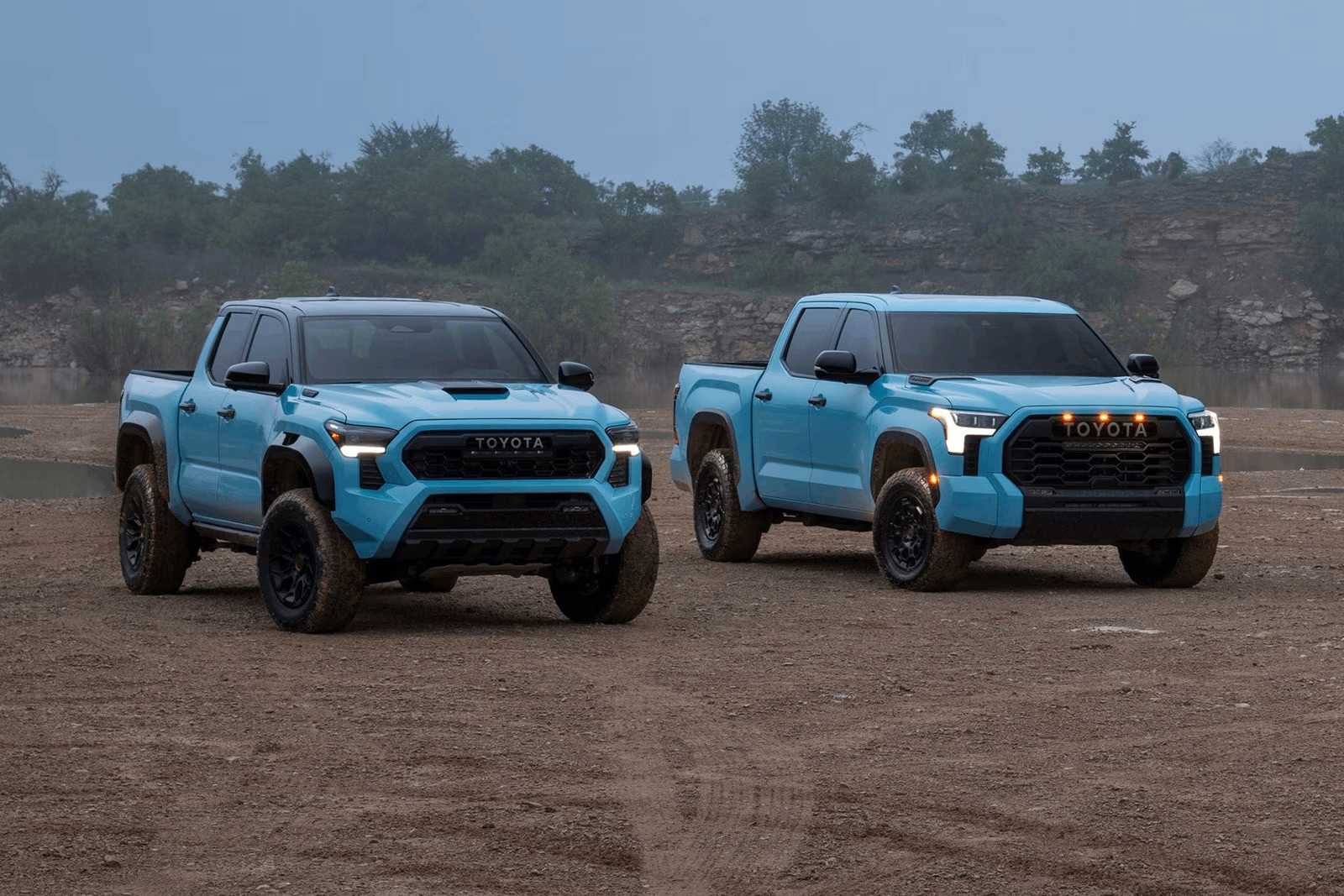
The Tundra vs. Tacoma question comes up constantly among Toyota truck buyers, and honestly, it's worth taking seriously. Both trucks are reliable, well-equipped, and genuinely capable. But they're built for different jobs. At Longo Toyota in El Monte, CA, we work with buyers every day who are navigating exactly this decision. This guide covers the 2026 models on everything that matters: size, power, towing, off-road ability, fuel economy, and fit for your lifestyle. Explore our new inventory to see what's available right now.
Tundra vs. Tacoma: Understanding the Core Difference Before You Choose
Here's what people often miss: these aren't competing trucks. They serve genuinely different purposes. The Tundra is a full-size truck built for heavy hauling, larger payloads, and drivers who need serious capability on a regular basis. The Tacoma is midsize, designed for versatility, whether that's city streets, weekend trail runs, or light-to-moderate work.
The simplest way to think about it is this: how much truck do you actually need? Answering that honestly gets you to the right choice faster than any spec sheet will.
Size, Cab Configurations, and Bed Options
Size is where these two trucks diverge most visibly, and it affects everything from parking ease to interior room and cargo capacity. The Tacoma is compact enough to feel manageable in urban environments without giving up the utility that makes a truck worth owning.
2026 Tacoma Dimensions and Configurations
The 2026 Tacoma comes in two cab styles: XtraCab and Double Cab, with bed lengths of 5 feet or 6 feet. That's a practical footprint for most driveways, parking garages, and trailheads around Southern California. Four adults fit comfortably, and the bed handles gear, lumber runs, and recreational equipment without complaint.
2026 Tundra Dimensions and Configurations
The Tundra is offered in Double Cab and CrewMax configurations, with bed options of 5.5 feet, 6.5 feet, or 8.1 feet. Rear seats in the CrewMax are genuinely spacious, making long drives comfortable for families or work crews. If you regularly haul large items or need to seat five or more adults without squeezing anyone in, the Tundra's size is a real practical advantage.
Engine and Performance: How Each Truck Is Powered
Both 2026 Toyota trucks offer turbocharged powertrains and hybrid options, but their outputs are matched to their respective roles.
2026 Tacoma Powertrain Options
Three engine choices come with the 2026 Tacoma. The base i-FORCE 2.4L Turbo 4-Cylinder produces 228 hp and 243 lb-ft of torque, handling daily driving and light hauling well. Higher trims step up to 278 hp and 317 lb-ft, which makes a noticeable difference in highway merging and loaded driving. The i-FORCE MAX 2.4L Turbo Hybrid brings 326 hp and 465 lb-ft for those who want efficiency alongside performance. Most trims pair with an 8-speed automatic, though a 6-speed manual is available.
2026 Tundra Powertrain Options
The Tundra starts with serious power. The base i-FORCE 3.4L Twin-Turbo V6 produces 348 hp and 405 lb-ft of torque. Higher trims push that to 389 hp and 479 lb-ft, all paired with a 10-speed automatic. Upgrade to the i-FORCE MAX 3.4L Twin-Turbo V6 Hybrid and output climbs to 437 hp and 583 lb-ft. These powertrains are engineered for sustained heavy use, not just the occasional loaded run.
Towing and Payload: Which Truck Can Handle Your Haul?
This is where the size and power gap translates into real-world numbers, and the difference is substantial.
The 2026 Tacoma maxes out at 6,500 lbs of towing capacity with a maximum payload of 1,705 lbs. That covers a mid-size boat, a loaded utility trailer, or recreational gear without issue. What it isn't built for is sustained heavy commercial loads.
The 2026 Tundra tows up to 12,000 lbs with a maximum payload of 1,850 lbs. For buyers who regularly pull fifth-wheel campers, horse trailers, or equipment trailers on SoCal freeways, that extra capacity isn't a luxury. If your hauling needs routinely push past 6,500 lbs, the Tundra isn't just a preference; it's the only practical choice.
Have questions about which configuration fits your towing needs? Contact our team at Longo Toyota and we'll help you sort it out.
Off-Road Capability: How the TRD Packages Stack Up
Both trucks offer TRD off-road packages and both are genuinely capable on dirt, but the experience differs in meaningful ways.
The Tacoma has earned a strong reputation as one of the most capable midsize off-road trucks you can buy. TRD Off-Road and TRD Pro trims include multi-terrain select, crawl control, a locking rear differential, and skid plates. The Trailhunter package goes further, pairing the i-FORCE MAX hybrid powertrain with electronically disconnecting antiroll bars for serious articulation on technical terrain. The Tacoma's lighter weight, shorter wheelbase, and tighter turning radius give it a real agility advantage on the narrow trails throughout Southern California's backcountry.
The Tundra's TRD Off-Road and TRD Pro trims bring comparable technology, including an electronic locking rear differential, crawl control, and multi-terrain select. Where the Tundra earns its reputation is in stability and confidence on rugged terrain. The extra power and size create a commanding presence the Tacoma simply can't match at scale. Where the Tacoma is nimble, the Tundra is powerful. Both are valid off-road approaches, but the right one depends on the trails you're actually driving.
Fuel Economy and Daily Drivability: Tacoma vs. Tundra MPG
Fuel economy is one area where the Tacoma has a natural edge, mostly because of its smaller engines and lighter curb weight.
The 2026 Tacoma with the base engine is EPA-estimated at up to 20 MPG city and 26 MPG highway. The i-FORCE MAX hybrid improves those figures further. For a truck this capable, those numbers are competitive.
The 2026 Tundra with the standard twin-turbo V6 is rated at 18 MPG city and 24 MPG highway. The i-FORCE MAX hybrid improves on that meaningfully, making it a smart pick for buyers who want full-size capability without constant fuel stops.
One other thing worth noting: both trucks come standard with Toyota Safety Sense, though versions differ. The Tacoma includes Toyota Safety Sense 3.0, while the Tundra includes Toyota Safety Sense 2.5.
Both trucks are comfortable on the highway and easy to live with daily. The Tundra's larger cabin and smoother highway manners make long drives feel more relaxed; the Tacoma's smaller footprint keeps city and suburban driving genuinely manageable.
Value and Long-Term Ownership: Tacoma vs. Tundra
Both trucks represent strong long-term value, though for different reasons. If your needs fit within what the Tacoma can do, its smaller footprint, better fuel economy, and lower operating costs add up over time. There's no benefit in buying more truck than you'll actually use.
On the other hand, if you're regularly pushing a truck to its limits with heavy towing, large payloads, or full-family comfort, the Tundra's additional capability is an investment in tools you'll actually use. Both trucks hold their value well, which is a direct reflection of the durability Toyota is known for. The best value is whichever one matches your realistic use case, not whichever one has more features on paper.
2026 Tacoma vs. Tundra: Side-by-Side Specs
| Specification | 2026 Tacoma | 2026 Tundra |
| Classification | Midsize Pickup | Full-Size Pickup |
| Standard Engine (Base) | i-FORCE 2.4L Turbo 4-Cyl | i-FORCE 3.4L Twin-Turbo V6 |
| Horsepower / Torque (Base) | 228 hp / 243 lb-ft | 348 hp / 405 lb-ft |
| Horsepower / Torque (Higher Trims) | 278 hp / 317 lb-ft | 389 hp / 479 lb-ft |
| Hybrid Option (i-FORCE MAX) | 326 hp / 465 lb-ft | 437 hp / 583 lb-ft |
| Transmission | 8-Spd Auto / 6-Spd Manual | 10-Spd Automatic |
| Cab Configurations | Double Cab, XtraCab | Double Cab, CrewMax |
| Bed Lengths | 5 ft, 6 ft | 5.5 ft, 6.5 ft, 8.1 ft |
| Max Towing Capacity | 6,500 lbs | 12,000 lbs |
| Max Payload Capacity | 1,705 lbs | 1,850 lbs |
| Fuel Economy (City / Hwy) | Up to 20 / 26 mpg | 18 / 24 mpg |
| Standard Safety Suite | Toyota Safety Sense 3.0 | Toyota Safety Sense 2.5 |
Which Toyota Truck Is Right for You?
If you've been going back and forth on this, here's how to cut through it by buyer profile.
Weekend off-roaders and overlanders who prioritize trail agility, lighter weight, and technical terrain performance should go with the Tacoma, specifically the TRD Pro or Trailhunter trim. The hardware is purpose-built for exactly that kind of use.
Daily commuters and urban drivers in El Monte, CA and the surrounding area who want a capable, fuel-efficient truck without wrestling a full-size into tight parking spots belong in a Tacoma. Its smaller footprint makes routine driving noticeably less stressful.
Contractors, tradespeople, and anyone who regularly hauls heavy equipment or tows large trailers should choose the Tundra. The 12,000-lb towing capacity and 1,850-lb payload aren't extras; they're the reason to buy it.
Families who spend significant time on road trips or need genuine rear-seat comfort for adults will be better served by the Tundra's CrewMax cab and expanded bed options.
Want to get a feel for both trucks before committing? Take a virtual test drive to explore each model from home.
Explore the 2026 Tundra and Tacoma at Longo Toyota
Specs only tell you so much. The clearest way to settle this debate is to get behind the wheel of both. We carry the 2026 Tundra and 2026 Tacoma across a wide range of trims and configurations at our El Monte, CA location.
Explore our new inventory to see current availability, or get a trade-in estimate if you're ready to move on from your current vehicle. Our team is here to help you find the right configuration for your needs. Contact our team with any questions or to schedule a visit.